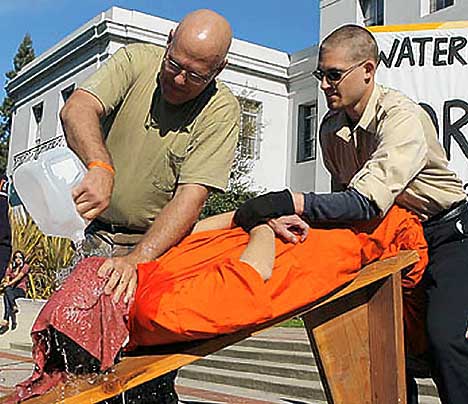
A recent New York Times opinion piece "Torture Versus War" asks "What is it about the terrible intimacy of torture that so disturbs and captivates the public? Why has torture long been singled out for special condemnation in the law of war, when war brings death and suffering on a scale that dwarfs the torture chamber?" The author then proceeds to indulge in some hand-wringing over the effectiveness of torture in eliciting information, and to a lesser extent itslegality, with scarcely a mention of moral and ethicalconsiderations. And he appears, to me at least, to take as given that war is perfectly reasonable, in terms of efficacy, legality, morality and ethics, and to assume that his readers must accept this position.
These are exactly the kind of hypocritical moral contortions that make me see red!
Firstly, let me say it plainly: TORTURE IS WRONG. In defending the Bush administration's torture program, Republicans have likened the "high-value" detainees to mass murderers, who don't deserve to be treated humanely. The Republicans seem to have a gift for always missing the moral crux of every question. By deeming any other human being as "unworthy of humane treatment", one denies one's own humanity, and hence, I would think, one's own worthiness of humane treatment - a dangerous position to take. There are not now, nor can there ever be, extenuating circumstances, legal posturings or moral arguments that can change that. So, once again: TORTURE IS WRONG, ALWAYS!
But what really angers, shames, disgusts me is the bland assumption that everyone agrees that war is a perfectly acceptable political instrument. Wrong. I would venture to say that almost no "rational" human being accepts that view. What is almost universally accepted is that despite any misgivings or moral qualms that may exist, somehow nation-states possess an inalienable right to wage war. Poppycock! Where did this cockeyed notion come from, that somehow disembodied entities - states, corporations - have rights beyond those of individuals, that there is somehow a different set of ethical values that applies, apparently simply by dint of their supra-individual character?
The ten commandments of the old testament have become controversial in the U.S., but nevertheless I think we can all agree that the proscription of murder, theft, adultery and other anti-social behavior simply codifies an ethical stance that is almost universal, Further, it seems plain to me that ethics and morality are the foundation of all law. No one seems to have any objections to the notion that an individual has no ethical right to seek to achieve an end, no matter how just that end may be, through violent means, nor to the codification of that view into law. True, the law sets forth the notions of extenuating circumstances, justifiable homicide, self-defence, but these are all subsidiary to the essential moral truth. So I ask again: if an individual is subject to this ethic, and bound by the laws based upon it, how is it that nations and corporations are held to a lower standard? As I can imagine no argument from ethics to support this standard, I can only conclude that it exists purely through coercion. In the case of nations through the near-monopoly of violence enjoyed by the state. In the case of the corporation, the enormous economic coercive power it enjoys - though the rise of privatized arms of state violence is a deeply disturbing new development.
But if it is wrong, ethically, legally, for an individual to try to achieve his ends through violence, then surely it is, if anything, more wrong for the state or corporation, given their enormously greater destructive power? In which case it would appear logical to impose more stringent laws against state and corporate violence. To which the standard response is that the state monopoly of violence is required to control the violence of criminal citizens, and as a defense against the violence of other (always "less civilized") states. This position is based upon a false premise, whose falsity moreover is taken as given in the case of the individual: namely that violence is an acceptable tool, and that violence is the only available response to violence.
I would like to humbly suggest that this is complete and utter hogwash. While it will probably remain true for the foreseeable future that there exists no greater coercive power than the individual nation state to curb the "natural" tendency to violence of nation states - the UN has repeatedly proved itself to be utterly impotent - this does not mean that war is ever justifiable or necessary. One might think that the the failure of the "Great War to End Wars" to do any such thing would be proof enough of that.
So if on the one hand violence is unacceptable, and on the other there is no power great enough to curb the violence of nations, what is to be done?
Firstly we need to take seriously the ancient idea that in fact the the only legitimate response to violence is loving kindness.
Secondly, each of us, as an individual, has the moral duty to oppose state violence, and to oppose the production, distribution and use of the tools of that violence. Siddhārtha Gautama, Jesus of Nazareth, Mahatma Gandhi, Dr. Martin Luther King, Jr. and countless other unsung heroes have shown in word and deed what must be done. If we fail, the 21st century is already shaping up to make the 20th, the bloodiest in history, look like the garden of Eden.
"You may say I'm a dreamer, but I'm not the only one"
VIOLENCE IS WRONG, ALWAYS! TORTURE IS WRONG, ALWAYS! WAR IS WRONG, ALWAYS!
Andrew Maben
http://wow-thats-deep.blogspot.com/


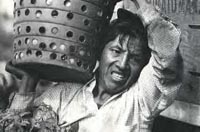 The CIW is a community-based worker organization. Our members are largely Latino, Haitian, and Mayan Indian immigrants working in low-wage jobs throughout the state of Florida.
  Southwest Florida is the state's most important center for agricultural production, and Immokalee is the state's largest farmworker community. As such, the majority of our more than 2,500 members work for large agricultural corporations in the tomato and citrus harvests, traveling along the entire East Coast following the harvest in season. Many local residents, and thus many of our members, move out of agriculture and into other low wage industries that are important in our area, including the construction, nursery, and tourist industries. The community is split, roughly, along the following ethnic/national origin lines: Mexican 50%, Guatemalan 30%, Haitian 10% and other nationalities (mostly African-American) 10%.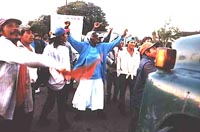
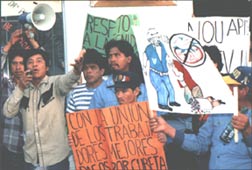 dollars annually for the community in increased wages) and a new-found political and social respect from the outside world.
 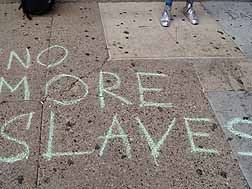 against indentured servitude came in January of 2007, when a crewleader by the name of Ron Evans was sentenced to 30 years in prison. You can read more about the Evans case and the CIW's work against the most extreme forms of farm labor exploitation by clicking on the following link:
  Group against Human Trafficking through its Center for the Advancement of Human Rights.
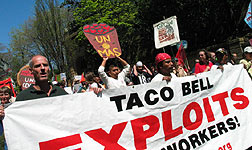
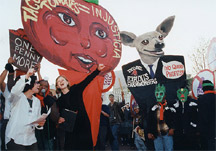 The Taco Bell boycott gained broad student, religious, labor, and community support in the nearly four years since its inception, including the establishment of boycott committees in nearly all 50 states and a fast-growing movement to "Boot the Bell" from college and high school campuses across the country. Large scale national actions helped move the boycott forward. For example, in 2003 we organized a 10-day hunger strike outside of Taco Bell headquarters in Irvine, CA -- one of the largest hunger strikes in US labor history, with over 75 farmworkers and students fasting during the 10-day period -- galvanizing the support of national religious, labor, and student organizations and thousands of individuals. During that strike we posed Taco Bell’s executives one question: “Can Taco Bell guarantee its customers that the tomatoes in its tacos were not picked by forced labor?” The company had no answer. In 2004 and 2005, we organized cross-country tours featuring marches and actions in Louisville, KY, and Irvine, CA, lifting the campaign to new heights.
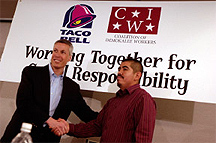 In March 2005, amidst growing pressure from students, churches, and communities throughout the country, Taco Bell agreed to meet all of our demands to improve wages and working conditions for Florida tomato pickers in its supply chain. The boycott victory was celebrated by observers including former President Jimmy Carter, former guitarist for Rage Against the Machine, Tom Morello, and the 21 members of the Congressional Hispanic Caucus. The Hispanic Caucus said of the accord, "This is a truly historic agreement, marking perhaps the single greatest advance for farm workers since the early struggles of the United Farm Workers. To the the workers and organizers of CIW, we express our deepest gratitude for their determined work for their own dignity and their historic contribution to advancing the cause of labor rights."
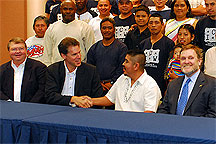 And in April of 2007 -- following a two-year battle with the largest restaurant chain in the world, McDonald's -- the Campaign for Fair Food took an important new step forward. With an announcement at the Carter Center in Atlanta (President Jimmy Carter's center for conflict resolution), McDonald’s and the CIW reached a landmark accord that not only met the standards set in the Taco Bell agreement, but also committed the fast-food leader to collaborate with the CIW in developing an industry-wide third party mechanism for monitoring conditions in the fields and investigating abuses.
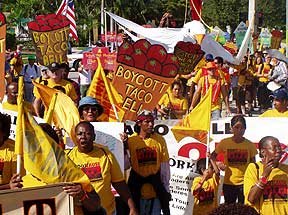 Over the past several years, through the Campaign for Fair Food and our anti-slavery work, Immokalee has evolved from being one of the poorest, most politically powerless communities in the country to become today a new and important public presence with forceful, committed leadership directly from the base of our community -- young, immigrant workers forging a future of livable wages and modern labor relations in Florida's fields. In recognition of their work, three CIW members were recently presented the prestigious 2003 Robert F. Kennedy Human Rights Award, the first time the award has gone to a US-based organization in its 20 years of existence. In recent years, the CIW and the Campaign for Fair Food have been recognized by several other institutions, including the World Hunger Year's 2006 Harry Chapin Self-Reliance Award, the Freedom Network's 2006 Wellstone Award, and the 2005 Business Ethics Network's BENNY Award.


.jpg)

